
La Sagrada Familia: The Temple of Ambition and Faith Rising Above Barcelona.
La Sagrada Familia is not just a monument—it’s a living masterpiece, an architectural miracle in constant evolution, and the ultimate symbol of faith and creativity. Conceived by the visionary Antoni Gaudí, this basilica has become the beating heart of Catalan modernism and the undisputed icon of Barcelona.
Recently, the Sagrada Familia reached a historic milestone: with the placement of the cross atop the tower of Jesus Christ, it now holds the title of the tallest church in the world, surpassing 162 meters and moving closer to its final height of 172.5 meters. This achievement marks a new chapter in a story that began more than a century ago.
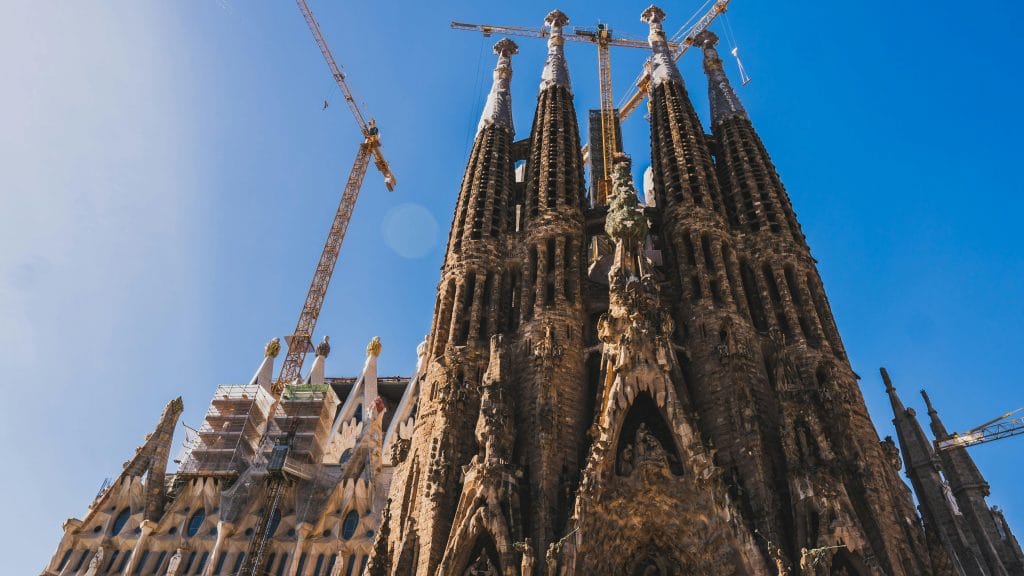
But the Sagrada Familia is more than stone and stained glass. It’s a spiritual and cultural experience—a place where ambition meets devotion, and where every detail tells a story of perseverance and artistry. For slow travelers and city break enthusiasts, visiting this architectural wonder is not about rushing through a checklist; it’s about immersing yourself in the essence of Barcelona, taking the time to appreciate the harmony between nature, geometry, and faith that Gaudí envisioned.
Este templo, que lleva más de un siglo en construcción, es mucho más que piedra y vidrieras; es el corazón palpitante del modernismo catalán y el icono indiscutible de Barcelona.
The Genius Behind the Masterpiece: Antoni Gaudí.
La Sagrada Familia is more than stone and stained glass—it’s the living heart of Catalan Modernism and the ultimate symbol of Barcelona. Behind this extraordinary work stands Antoni Gaudí i Cornet (1852–1926), a visionary architect, a deeply spiritual man, and an untiring observer of nature.
Born in Reus, Catalonia, Gaudí moved to Barcelona to study architecture and soon became the leading figure of Catalan Modernism. For Gaudí, architecture was a sacred mission—a “Great Work” dedicated to God. Nature was his greatest teacher, and he avoided straight lines, considering them unnatural. Instead, his designs overflow with organic forms: helical columns reminiscent of tree trunks, structures inspired by skeletons and leaves, and flowing curves that echo the harmony of the natural world.
Gaudí’s genius extended to engineering. He pioneered innovative structural solutions, using ruled geometry—hyperboloids, paraboloids—to create strong yet elegant vaults and columns, reducing the need for external buttresses. These techniques not only enhanced stability but also gave the basilica its unique aesthetic.
In 1883, at just 31 years old, Gaudí took over the Temple Expiatori de la Sagrada Família, which had begun a year earlier in a neo-Gothic style. He radically transformed the project, dedicating the last twelve years of his life exclusively to this monumental work. His devotion was so complete that he lived in the workshop, fully immersed in what he called the “cathedral of the poor.”
Tragically, Gaudí died in 1926 after being struck by a tram, leaving the basilica unfinished. Today, his remains rest in the crypt of the Sagrada Familia—a fitting tribute to the man whose vision continues to shape Barcelona’s skyline.
💡 A Key fact: One of the most fascinating aspects of La Sagrada Familia is Gaudí’s absolute devotion. For the last 12 years of his life, he dedicated himself exclusively to this monumental project, living almost entirely on-site. His commitment was so profound that many believe the final design existed more in his mind than on paper. Today, the ongoing construction is a remarkable exercise in architectural forensics, interpreting Gaudí’s original models and vision to bring his masterpiece to completion.
Gaudí’s Lifelong Devotion to His Masterpiece.
The true grandeur of the Sagrada Familia lies in its deep symbolism. This basilica is not just a building—it’s a gigantic catechism carved in stone. Every detail speaks of faith, redemption, and the human journey. To fully appreciate its impact, you must understand the message behind its three iconic facades:
| Fachada | Simbolismo Principal | El Estilo de Gaudí |
|---|---|---|
| The Nativity Facade (Est) | Life, Joy, and Hope. | This is the most vibrant and organic of the three facades—a celebration of Christ’s birth. It bursts with naturalistic details: animals, plants, and intricate carvings that evoke the abundance of life. It’s also the only facade Gaudí saw nearly completed, making it a true reflection of his vision.. |
| The Passion Facade (West) | Sacrifice, Death, and Resurrection. | In stark contrast, the Passion Facade is austere and dramatic. Its bare, angular lines and expressionist sculptures convey suffering and tragedy, inviting deep reflection on the sacrifice of Christ. This facade is designed to move visitors emotionally. |
| The Glory Facade (Sud) | The Path to God and Eternal Life. | Still under intense construction, the Glory Facade will be the most monumental of all. It represents the journey from the earthly to the divine, depicting the Last Judgment and the promise of eternal life. When completed, it will serve as the grand entrance to the basilica. |
💡 Slow Travel Tip: Instead of rushing through, take time to walk around the basilica and observe the details of each facade. Notice the symbolism, the craftsmanship, and the way light interacts with the stone. This is where slow travel transforms a visit into a profound experience.
The Icon of Barcelona.
La Sagrada Familia is more than a landmark—it’s the defining symbol of Barcelona, and here’s why:
Architectural Identity: It stands as the ultimate expression of Catalan Modernism, the artistic movement that shaped Barcelona’s identity at the turn of the 20th century. Gaudí’s vision fused Gothic tradition with organic forms, creating a style that is both timeless and revolutionary.
Persistence and Faith: This basilica embodies tenacity and devotion, a project carried forward by generations despite wars, funding challenges, and technical obstacles. It’s a living work that transcends its creator, reminding us that great dreams require patience.
Universal Appeal: With its unique design—a blend of Gothic elements and nature-inspired geometry—La Sagrada Familia attracts millions of visitors every year, making it the most visited monument in Spain and a must-see for any Barcelona itinerary.
Beacon of the City: Its monumental towers dominate Barcelona’s skyline, pointing toward the heavens and anchoring the city to a vision of beauty and hope. When completed in 2026, the basilica will mark a global celebration—the culmination of an architectural dream over 140 years in the making.
La Sagrada Familia is, at its core, the ambition of a man of faith—a structure designed to bring heaven closer to earth. Its completion in 2026 will be a global celebration, the culmination of an architectural dream without precedent.
But while La Sagrada Familia is the heart of Barcelona, the city has an infinite soul. It’s an icon because it represents Catalonia’s dual essence: deep-rooted tradition intertwined with a bold, forward-looking vision. When you open yourself to this duality—the sacred and the everyday, the monumental and the intimate—you discover that Catalonia is a land to be experienced with all five senses.
That’s why at AMAjourney, we’ve created Mindful Travel experiences designed to help you explore this heritage with connection, calm, and conscious curiosity. Our itineraries invite you to slow down, savor the details, and immerse yourself in the authentic rhythm of Barcelona and beyond.